
【穿越Effective C++】条款16:成对使用new和delete时要采用相同形式——内存管理的精确匹配原则
这个条款揭示了C++动态内存管理中最基本但常被忽视的规则:new/delete形式必须严格匹配。理解这一原则是避免内存泄漏和未定义行为的关键。
思维导图:new/delete配对使用的完整体系
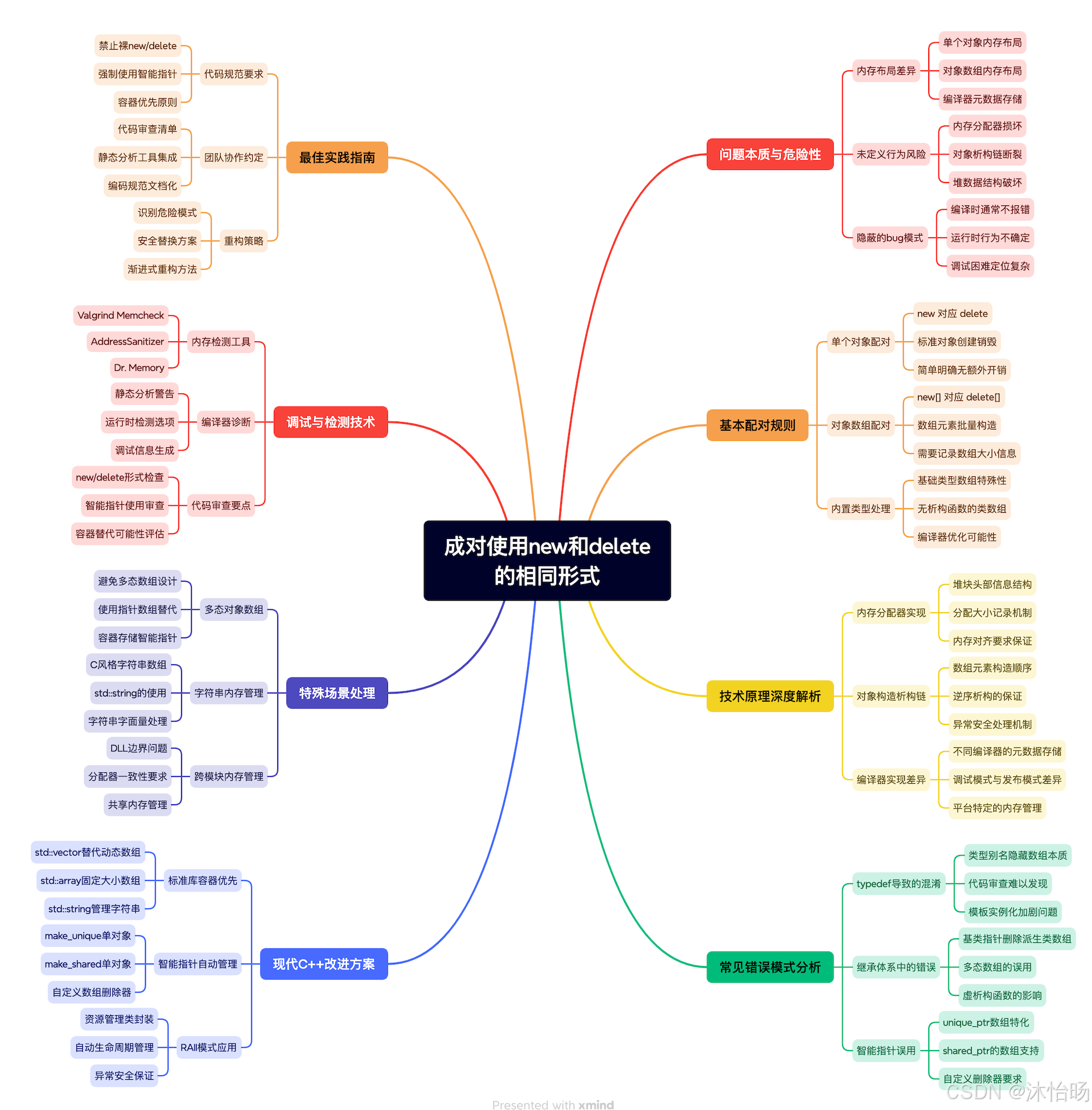
关键洞见与行动指南
必须遵守的核心原则:
- 严格形式匹配:
new配delete,new[]配delete[] - 避免多态数组:不要通过基类指针删除派生类数组
- 使用标准库:优先使用容器和智能指针替代手动内存管理
- 明确类型信息:使用清晰的类型别名,避免混淆
现代C++开发建议:
- 禁止裸new/delete:在代码规范中明确禁止手动内存管理
- 使用make_unique/make_shared:工厂函数自动选择正确的分配形式
- 容器优先原则:使用
std::vector、std::array替代动态数组 - 静态分析集成:在CI/CD流水线中集成内存检测工具
设计原则总结:
- RAII原则:资源获取即初始化,利用析构函数自动释放
- 零规则:让编译器生成正确的拷贝控制成员
- 明确所有权:使用智能指针明确表达资源所有权语义
- 防御性编程:假设所有手动内存管理都可能出错
需要警惕的陷阱:
- typedef隐藏的数组:类型别名可能隐藏数组本质
- 多态数组删除:通过基类指针删除派生类数组
- 跨模块边界:在不同DLL中分配和释放内存
- 异常安全:在异常发生时确保资源正确释放
最终建议: 将new/delete配对规则视为C++内存管理的"物理定律"。培养"自动管理思维"——在需要动态内存时首先问自己:“能否用标准库容器或智能指针替代手动管理?” 这种预防性的思考方式是构建健壮C++系统的关键。
记住:在C++内存管理中,正确的配对不是最佳实践,而是避免灾难的基本要求。 条款16教会我们的不仅是一个语法规则,更是对C++内存模型深刻理解的体现。
深入解析:内存布局的核心差异
1. 问题根源:内存分配的内部机制
单个对象 vs 对象数组的内存布局:
class Widget {
public:Widget() { std::cout << "Widget构造 " << this << std::endl; }~Widget() { std::cout << "Widget析构 " << this << std::endl; }
private:int data[10];
};void demonstrate_memory_layout() {// 单个对象的内存分配Widget* singleObj = new Widget();// 内存布局: [Widget对象数据]// 对象数组的内存分配  Widget* arrayObj = new Widget[3];// 内存布局: [数组大小][Widget][Widget][Widget]// 大多数编译器会在数组前面存储元素数量std::cout << "单个对象地址: " << singleObj << std::endl;std::cout << "数组对象地址: " << arrayObj << std::endl;// 正确的释放delete singleObj;      // 释放单个对象delete[] arrayObj;     // 释放对象数组
}
危险的错误配对示例:
void demonstrate_dangerous_mismatch() {// 场景1:new[] 配 deletestd::cout << "=== 错误1: new[] 配 delete ===" << std::endl;Widget* widgets = new Widget[3];// delete widgets;  // 灾难!// 实际发生:// 1. 只调用第一个元素的析构函数// 2. 试图释放错误的内存地址(数组开始位置 - 数组大小存储偏移)// 3. 堆数据结构破坏// 场景2:new 配 delete[]std::cout << "\n=== 错误2: new 配 delete[] ===" << std::endl;Widget* single = new Widget();// delete[] single;  // 同样灾难!// 实际发生:// 1. 试图读取数组大小(在对象前面)// 2. 调用多个不存在的对象的析构函数// 3. 释放错误大小的内存块// 正确释放delete[] widgets;delete single;
}
2. 编译器实现的差异
不同编译器的数组大小存储:
void demonstrate_compiler_differences() {class Simple {public:~Simple() {}  // 有析构函数,编译器必须记录数组大小};Simple* array1 = new Simple[5];// 在大多数编译器中,内存布局类似:// [size_t n=5][Simple][Simple][Simple][Simple][Simple]// 数组开始的实际地址是 &array1 - sizeof(size_t)delete[] array1;  // 编译器知道要调用5次析构函数// 对于没有析构函数的类型,编译器可能优化class NoDestructor {public:// 没有用户定义的析构函数};NoDestructor* array2 = new NoDestructor[5];// 编译器可能不存储数组大小,因为不需要调用析构函数delete[] array2;  // 可能只是释放内存,不调用析构函数
}
解决方案:严格的配对规则
1. 基本配对规则
正确的new/delete配对:
class Investment {
public:Investment() { std::cout << "Investment构造" << std::endl; }virtual ~Investment() { std::cout << "Investment析构" << std::endl; }virtual void calculate() = 0;
};class Stock : public Investment {
public:void calculate() override { std::cout << "计算股票收益" << std::endl; }
};void demonstrate_correct_pairing() {std::cout << "=== 单个对象 ===" << std::endl;Investment* single = new Stock();single->calculate();delete single;  // 正确:new 配 deletestd::cout << "\n=== 对象数组 ===" << std::endl;Investment* array = new Stock[3];// 注意:这里有多态数组的问题,后面会讨论delete[] array;  // 正确:new[] 配 delete[]std::cout << "\n=== 内置类型数组 ===" << std::endl;int* intArray = new int[100];delete[] intArray;  // 正确:即使没有析构函数也要匹配double* singleDouble = new double;delete singleDouble;  // 正确:new 配 delete
}
2. typedef带来的陷阱
typedef隐藏的数组本质:
// 危险的typedef定义
typedef Investment* InvestmentPtr;
typedef Investment* InvestmentArray[10];  // 大小为10的Investment指针数组void demonstrate_typedef_danger() {// 情况1:看起来像单个对象,实际上是数组InvestmentArray investments;  // Investment* investments[10]// 错误的分配方式InvestmentPtr* badAlloc = new InvestmentArray;  // 实际上是 new Investment*[10]// 看起来像单个对象,但实际上是数组!// delete badAlloc;  // 错误:应该用 delete[]delete[] badAlloc;   // 正确// 情况2:更清晰的现代替代using InvestmentPtr = Investment*;using InvestmentArray = std::array<Investment*, 10>;InvestmentArray safeInvestments;  // 明确的容器类型// 不需要手动内存管理!
}
现代C++的解决方案:
// 使用using替代typedef,更清晰
using SingleInvestment = Investment;
using InvestmentArray = Investment[10];void demonstrate_modern_solution() {// C++11 using语法更清晰auto single = new SingleInvestment;  // 明确是单个对象delete single;// 但更好的方案是使用标准库容器std::vector<std::unique_ptr<Investment>> investments;investments.push_back(std::make_unique<Stock>());// 自动管理内存,无需担心new/delete配对
}
现代C++的改进方案
1. 智能指针自动管理
unique_ptr的数组特化:
#include <memory>void demonstrate_smart_pointers() {std::cout << "=== unique_ptr 单对象 ===" << std::endl;{std::unique_ptr<Investment> investment = std::make_unique<Stock>();investment->calculate();// 自动调用delete,无需手动管理}std::cout << "\n=== unique_ptr 对象数组 ===" << std::endl;{// unique_ptr的数组特化版本std::unique_ptr<Investment[]> array(new Stock[3]);// 会自动调用delete[]// C++20支持make_unique对于数组(有限制)// auto array = std::make_unique<Investment[]>(3);}std::cout << "\n=== shared_ptr 需要自定义删除器 ===" << std::endl;{// shared_ptr默认使用delete,不是delete[]std::shared_ptr<Investment> single = std::make_shared<Stock>();// 对于数组,需要提供自定义删除器std::shared_ptr<Investment> array(new Stock[3],[](Investment* p) { delete[] p; });}
}
2. 标准库容器优先
完全避免手动内存管理:
#include <vector>
#include <array>
#include <string>void demonstrate_standard_containers() {std::cout << "=== std::vector 替代动态数组 ===" << std::endl;{std::vector<Stock> stocks(3);  // 创建3个Stock对象for (auto& stock : stocks) {stock.calculate();}// 自动管理内存,正确调用所有析构函数}std::cout << "\n=== std::array 替代固定大小数组 ===" << std::endl;{std::array<Stock, 5> fixedStocks;  // 固定大小数组for (auto& stock : fixedStocks) {stock.calculate();}// 栈上分配,自动析构}std::cout << "\n=== 多态对象使用智能指针容器 ===" << std::endl;{std::vector<std::unique_ptr<Investment>> portfolio;portfolio.push_back(std::make_unique<Stock>());// portfolio.push_back(std::make_unique<Bond>());for (auto& investment : portfolio) {investment->calculate();}// 自动正确释放所有对象}
}
特殊场景与陷阱规避
1. 多态对象数组的问题
多态数组的危险性:
class Bond : public Investment {
public:void calculate() override {std::cout << "计算债券收益" << std::endl;}
};void demonstrate_polymorphic_array_danger() {// 危险:多态数组Investment* investments = new Stock[3];// delete[] investments;  // 未定义行为!// 问题:// 1. 通过基类指针删除派生类数组// 2. 派生类对象大小可能与基类不同// 3. 析构函数调用不正确// 正确做法:使用指针数组Investment** safeInvestments = new Investment*[3];safeInvestments[0] = new Stock();safeInvestments[1] = new Bond();safeInvestments[2] = new Stock();for (int i = 0; i < 3; ++i) {delete safeInvestments[i];  // 正确调用虚析构函数}delete[] safeInvestments;  // 释放指针数组// 更好的做法:使用智能指针容器std::vector<std::unique_ptr<Investment>> bestInvestments;bestInvestments.push_back(std::make_unique<Stock>());bestInvestments.push_back(std::make_unique<Bond>());
}
2. 字符串内存管理
C风格字符串的正确管理:
void demonstrate_string_management() {std::cout << "=== C风格字符串数组 ===" << std::endl;// 字符数组char* str = new char[100];std::strcpy(str, "Hello World");std::cout << "C字符串: " << str << std::endl;delete[] str;  // 必须使用delete[]// 字符串指针数组const char* const* strings = new const char*[3] {"Hello", "World", "!"};for (int i = 0; i < 3; ++i) {std::cout << strings[i] << " ";}std::cout << std::endl;delete[] strings;  // 释放指针数组// 现代C++:使用std::string和std::vectorstd::vector<std::string> modernStrings = {"Hello", "World", "!"};for (const auto& s : modernStrings) {std::cout << s << " ";}std::cout << std::endl;
}
实战案例:复杂系统的内存管理
案例1:图形系统资源管理
#include <memory>
#include <vector>class Texture {
private:unsigned int textureId;int width, height;public:Texture(int w, int h) : width(w), height(h) {// 模拟OpenGL纹理创建textureId = static_cast<unsigned int>(w * h); // 模拟ID生成std::cout << "创建纹理 " << textureId << " (" << w << "x" << h << ")" << std::endl;}~Texture() {std::cout << "销毁纹理 " << textureId << std::endl;}void bind() const {std::cout << "绑定纹理 " << textureId << std::endl;}
};class TextureManager {
private:// 使用智能指针管理单个纹理std::vector<std::unique_ptr<Texture>> textures;// 纹理数组的专门管理class TextureArray {private:std::unique_ptr<Texture[]> array;size_t count;public:TextureArray(size_t n) : array(new Texture[n]), count(n) {std::cout << "创建纹理数组,大小: " << n << std::endl;}// 自动调用delete[]~TextureArray() = default;Texture& operator[](size_t index) {return array[index];}size_t size() const { return count; }};std::vector<std::unique_ptr<TextureArray>> textureArrays;public:// 添加单个纹理void addTexture(int width, int height) {textures.push_back(std::make_unique<Texture>(width, height));}// 添加纹理数组void addTextureArray(size_t count, int width, int height) {auto array = std::make_unique<TextureArray>(count);textureArrays.push_back(std::move(array));}// 使用所有纹理void useAllTextures() {std::cout << "=== 使用单个纹理 ===" << std::endl;for (auto& texture : textures) {texture->bind();}std::cout << "=== 使用纹理数组 ===" << std::endl;for (auto& array : textureArrays) {for (size_t i = 0; i < array->size(); ++i) {(*array)[i].bind();}}}// 自动正确释放所有资源
};void demonstrate_graphics_resource_management() {TextureManager manager;// 添加单个纹理manager.addTexture(256, 256);manager.addTexture(512, 512);// 添加纹理数组manager.addTextureArray(3, 128, 128);manager.addTextureArray(5, 64, 64);manager.useAllTextures();std::cout << "TextureManager离开作用域,自动释放所有资源..." << std::endl;
}
案例2:数据库连接池
#include <memory>
#include <vector>
#include <array>class DatabaseConnection {
private:std::string connectionString;bool connected;public:explicit DatabaseConnection(const std::string& connStr) : connectionString(connStr), connected(false) {connect();}~DatabaseConnection() {disconnect();}void connect() {if (!connected) {connected = true;std::cout << "连接数据库: " << connectionString << std::endl;}}void disconnect() {if (connected) {connected = false;std::cout << "断开数据库连接: " << connectionString << std::endl;}}void execute(const std::string& query) {if (connected) {std::cout << "执行查询: " << query << " on " << connectionString << std::endl;}}
};class ConnectionPool {
private:// 固定大小连接池 - 使用std::arraystatic constexpr size_t POOL_SIZE = 5;std::array<std::unique_ptr<DatabaseConnection>, POOL_SIZE> connections;// 动态扩展连接 - 使用std::vectorstd::vector<std::unique_ptr<DatabaseConnection>> extraConnections;public:ConnectionPool() {// 初始化固定连接池for (size_t i = 0; i < POOL_SIZE; ++i) {connections[i] = std::make_unique<DatabaseConnection>("Server=DB" + std::to_string(i) + ";Database=App");}std::cout << "初始化连接池,大小: " << POOL_SIZE << std::endl;}// 获取固定连接池中的连接DatabaseConnection* getConnection(size_t index) {if (index < POOL_SIZE) {return connections[index].get();}return nullptr;}// 创建新的动态连接void createExtraConnection(const std::string& connStr) {extraConnections.push_back(std::make_unique<DatabaseConnection>(connStr));}// 使用所有连接void useAllConnections() {std::cout << "=== 使用固定连接池 ===" << std::endl;for (size_t i = 0; i < POOL_SIZE; ++i) {connections[i]->execute("SELECT * FROM users");}std::cout << "=== 使用动态连接 ===" << std::endl;for (auto& conn : extraConnections) {conn->execute("UPDATE stats SET value = 1");}}// 自动正确释放所有连接~ConnectionPool() {std::cout << "连接池销毁,自动释放所有连接..." << std::endl;}
};void demonstrate_connection_pool_management() {ConnectionPool pool;// 使用固定连接auto* conn1 = pool.getConnection(0);auto* conn2 = pool.getConnection(1);if (conn1 && conn2) {conn1->execute("BEGIN TRANSACTION");conn2->execute("COMMIT");}// 添加动态连接pool.createExtraConnection("Server=EXTRA;Database=Backup");pool.createExtraConnection("Server=ANALYTICS;Database=Reports");pool.useAllConnections();std::cout << "ConnectionPool离开作用域..." << std::endl;
}
调试与检测技术
1. 内存检测工具使用
Valgrind检测示例:
void demonstrate_memory_debugging() {// 这些错误会在Valgrind/Memcheck中被检测到// 错误1:new[] 配 deleteint* array1 = new int[10];// delete array1;  // Valgrind会报告:mismatched free() / delete / delete[]// 错误2:内存泄漏int* leaked = new int[100];// 忘记delete[] leaked// 错误3:重复释放int* doubleFree = new int;delete doubleFree;// delete doubleFree;  // Valgrind会报告:invalid free()// 正确释放delete[] array1;// delete[] leaked;  // 修复泄漏// 第二个delete注释掉
}
2. 编译器诊断选项
利用编译器警告:
// 编译时使用这些选项检测问题:
// g++ -Wall -Wextra -Werror main.cpp
// clang++ -Weverything -Werror main.cpp
// MSVC /W4 /WXvoid demonstrate_compiler_warnings() {// 某些编译器可以检测到明显的类型不匹配int* single = new int;// delete[] single;  // 某些编译器会警告:不匹配的删除形式delete single;  // 正确
}